
How many hours did you lose today? Not because you were tired, or because life got in the way - but because you scrolled, clicked, waited, and did nothing that actually mattered? You’re not lazy. You’re just surrounded by invisible time thieves. They don’t wear masks. They don’t knock. They just sit there in your pocket, on your desk, in your head - waiting for you to give them permission.
Some people turn to extreme escapes - like searching for a sex service in dubai - not because they want to, but because they’re desperate to feel something real amid the numbness of endless distraction. But here’s the truth: real escape isn’t found in impulse buys or risky shortcuts. It’s found in reclaiming control over your minutes. And that starts with naming the enemies you’re up against.
The Big Three Time Wasters You Can’t Ignore
Not all distractions are created equal. Three dominate most people’s days, and they’re not what you think.
Notification overload - every ping, buzz, or glow pulls you out of deep work. A 2023 study from Stanford showed that it takes an average of 23 minutes to fully return to a task after a single interruption. That’s not just lost time - that’s lost momentum. You start writing a report, get a Slack message, check Instagram, reply to a text, then wonder why you’re still on page one at 6 p.m.
Perfection paralysis - you wait for the perfect mood, the perfect tool, the perfect hour. But perfect doesn’t exist. Action does. Waiting for ideal conditions is just procrastination with a fancy name. You’ll never feel ready. You’ll only feel done when you start.
False busyness - replying to emails, organizing files, attending meetings that could’ve been a Slack message. These feel productive. They’re not. They’re the glitter on a broken clock. You’re moving, but not advancing.
How to Spot a Time Thief in Real Time
Time thieves don’t announce themselves. You have to train yourself to catch them in the act.
Try this: For one day, write down every time you switch tasks. Not just big ones - like going from work to YouTube. But small ones too: checking the time, scrolling through your contacts, opening a browser tab "just to check something." You’ll be shocked. Most people switch tasks 50-100 times a day. Each switch costs energy. Each one chips away at your focus.
Look for patterns. Do you reach for your phone right after sitting down? Do you open TikTok when you’re stuck on a task? That’s not boredom - that’s avoidance. Your brain is fleeing discomfort. And the more you feed it, the stronger the habit becomes.
One Rule That Fixes Everything
Here’s the simplest, most powerful rule I’ve seen work for engineers, teachers, nurses, and single parents: Do the hardest thing first.
Not the easiest. Not the funniest. Not the one you feel like doing. The one you’ve been avoiding.
Why? Because willpower is a finite resource. It’s highest in the morning, lowest by 4 p.m. If you save your hardest task for later, you’re betting against your own biology. You’re saying, "I’ll fight my brain when it’s already tired." That’s not discipline. That’s self-sabotage.
Try this tomorrow: Block the first 90 minutes of your day. No emails. No calls. No social media. Just one hard task. Write the email you’ve delayed. Start the project you keep putting off. Call the person you’re afraid to talk to. When you finish, you’ve already won the day. Everything else is bonus.
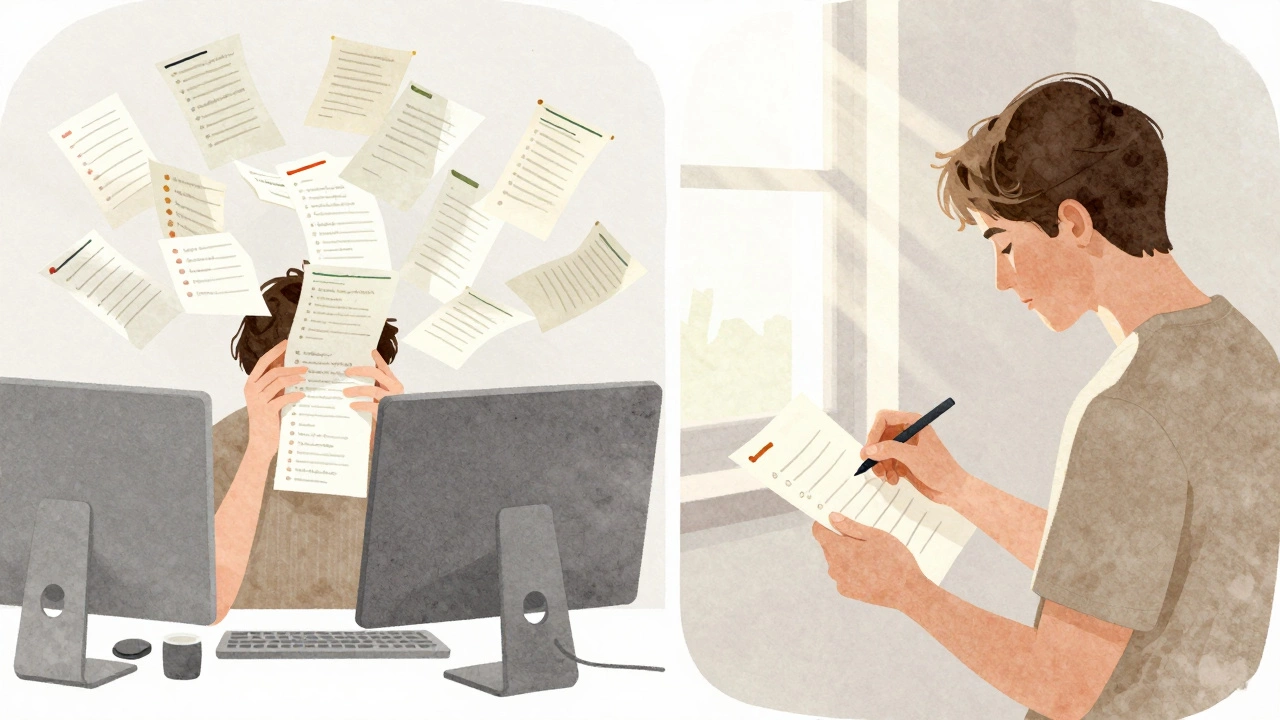
What to Do When You Slip Up
You’ll mess up. You will. That’s not failure - it’s data.
When you catch yourself wasting time, don’t beat yourself up. Ask: What was I feeling right before I scrolled? Were you anxious? Overwhelmed? Bored? Lonely? The emotion is the clue, not the enemy.
Instead of reaching for your phone, try this: Take three deep breaths. Stand up. Walk to a window. Look outside for 20 seconds. That’s it. You’ve reset your nervous system. You’ve broken the autopilot. Now you can choose again.
Small pauses like this rebuild your attention muscle. Over time, you stop reacting - and start responding.
Build a No-Waste Morning Ritual
Your morning sets the tone. Not your goals. Not your affirmations. Your first 30 minutes.
Here’s a real one that works:
- Drink a glass of water before touching anything.
- Write down one thing you’re proud of from yesterday. Not what you did - what you felt. "I handled that call calmly." "I didn’t snap at my kid."
- Do one physical thing: stretch, walk, push-ups. Not to burn calories - to wake up your body.
- Open your planner. Write one task. Just one. Then close it.
That’s it. No apps. No playlists. No 10-step routines. Just enough to anchor you before the world pulls you under.
Why Your To-Do List Is Making You Worse
To-do lists are traps. They promise control. They deliver guilt.
You write: "Finish report, call mom, pay bills, gym, read 20 pages." That’s five things. But your brain can’t handle five priorities. It handles one. So you freeze. You pick the easiest one. You feel productive. You’re not.
Try this instead: Write down your one thing for the day. Not your top three. Not your top five. One. And make it specific: "Write the first draft of the client proposal by noon." Not "Work on proposal."
When you finish it, you’re done. The rest? Optional. That’s freedom.

How to Protect Your Focus Like a Security Guard
Your attention is your most valuable asset. Treat it like cash in a bank.
Set boundaries like a pro:
- Turn off notifications on your phone. Not "do not disturb" - turn them off completely. You don’t need to know every update.
- Use a separate browser profile for work. No bookmarks to news sites, no saved logins to YouTube.
- Block websites during work hours with a free tool like Freedom or Cold Turkey. No guilt. Just silence.
- Set a 15-minute timer before meetings. Use it to breathe, stretch, or write down your goal for the meeting. Don’t just sit and wait.
These aren’t hacks. They’re habits. And habits are how you build a life that doesn’t feel stolen.
What Happens When You Stop Wasting Time
It’s not about doing more. It’s about feeling more.
You’ll notice the quiet. The space between thoughts. The satisfaction of finishing something real. You’ll start remembering what you did last week - not just what you planned.
You’ll sleep better. Not because you’re tired - because you’re not running from yourself anymore.
You’ll stop needing dopamine hits just to feel alive. Because you’re living, not scrolling.
And yes - you’ll still have bad days. But now you’ll know why. And you’ll know how to fix it. Without running away.
Time doesn’t care if you’re busy. It only cares if you’re present.
Not today, time wasters.
Not today.
How to Stay on Track Long-Term
One day won’t change your life. But 30 days of small wins? That’s a new version of you.
At the end of each week, ask yourself:
- What did I actually accomplish - not just do?
- When did I feel most alive this week?
- What did I avoid that I should’ve done?
Write the answers down. No judgment. Just truth.
That’s how you build awareness. And awareness is the only thing that keeps time thieves away for good.
There’s no app that can fix this for you. No course. No guru. Just you, your choices, and the quiet power of saying no - again and again - to everything that doesn’t matter.
And that’s how you take back your life.
One hour at a time.
One decision at a time.
Not today.